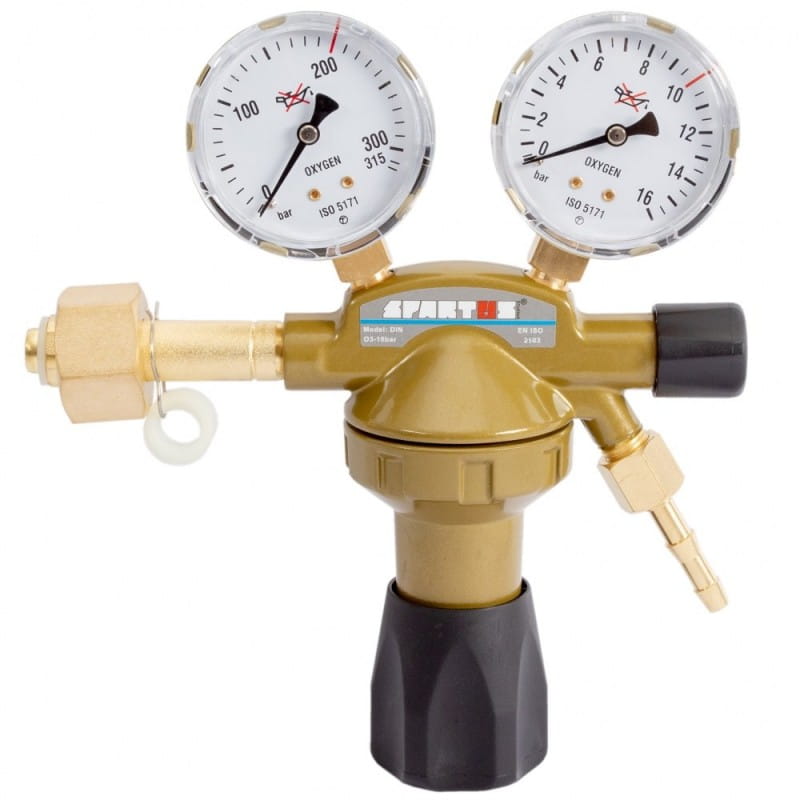
The welding gas regulator plays a key role in controlling the pressure of the gases used during welding. These gases, such as argon, MIX or carbon dioxide, are stored in cylinders under very high pressure. The regulator allows this pressure to be safely reduced to a level that is suitable for use in the welding process.
What is a welding reducer?
Regardless of the welding method used, most welding uses pressurized shielding gases. That's why it's so important to have the right reducer. What is this accessory? This is a device used to reduce the pressure of gas flowing from the cylinder. It helps maintain parameters at the appropriate level and at the same time protects against uncontrolled gas outflow.
How does a welding reducer work?
The gas pressure reducer, used in welding, can be equipped with a flange or threaded connection. A classic reducer consists of a body containing a throttling system. This system includes a pin, a lever, a spring and a valve. The mechanism is controlled by a flexible membrane.
Inside the reducer body there is a pin and a lever that transmit the movements of the diaphragm to the valve body. The obturator, connected to the lever by a spring, responds to every movement of the diaphragm. When the gas pressure acts on the diaphragm, the obturator closes and the spring acts in the opposite direction, opening it. When the pressure increases or decreases, the system automatically responds, restoring balance and stabilizing the outlet gas pressure.
Which reducer for welding should I choose?
The dual-clock regulator is equipped with two pressure gauges that enable monitoring of both the cylinder pressure and the working pressure after reduction. This reducer is most often used for MIG/MAG welding.
A reducer with a rotameter is a device that, in addition to regulating pressure, allows for accurate measurement of gas flow. A rotameter is a flow measurement device that consists of a transparent tube and a float. This version of the reducer is used in the TIG method, where the gas dose is more important for the entire process.
Pressure gauge and safety valve
The pressure in the welding cylinder must be kept under control at all times. A manometer is a device for measuring gas pressure. There may be one or two pressure gauges in the reducer. Located on the input side of the reducer, it measures the gas pressure directly from the cylinder. This allows you to monitor the amount of gas remaining in the cylinder. The second regulator of the reducer measures the gas pressure after reduction. This enables precise setting of the working pressure that is supplied to the welding equipment.
The safety valve is a key element that protects against excessive pressure in the system. When the gas pressure exceeds a set safe level, the safety valve automatically opens, releasing excess gas and thereby lowering the pressure to a safe level. This prevents damage to the reducer and other system components and minimizes the risk of accidents.
You will find a wide selection of reducers in our offer. Our products differ in parameters and intended use. Choose a product tailored to your needs!