


 Menu
Menu
Choose a category
- Soldering
- Tools
- Welding machines
- Weld bead cleaners
- Welding positioners
- Induction heaters
- Plasma cutters
- Rectifiers and starters
- Gas accessories
- Water coolers
- Trolleys
- Welding helmets
- Welding consumables
- Chemical
- Torches
- Abrasives
- Health and safety
- Spare parts
- Welding accessories
- Workshop tools
- Pneumatics
- New products
- Products on sale
Welder Fantasy JET TIG II AC/DC 200-S SPOT IGBT




Regular price:
product unavailable
add to wish list
Description
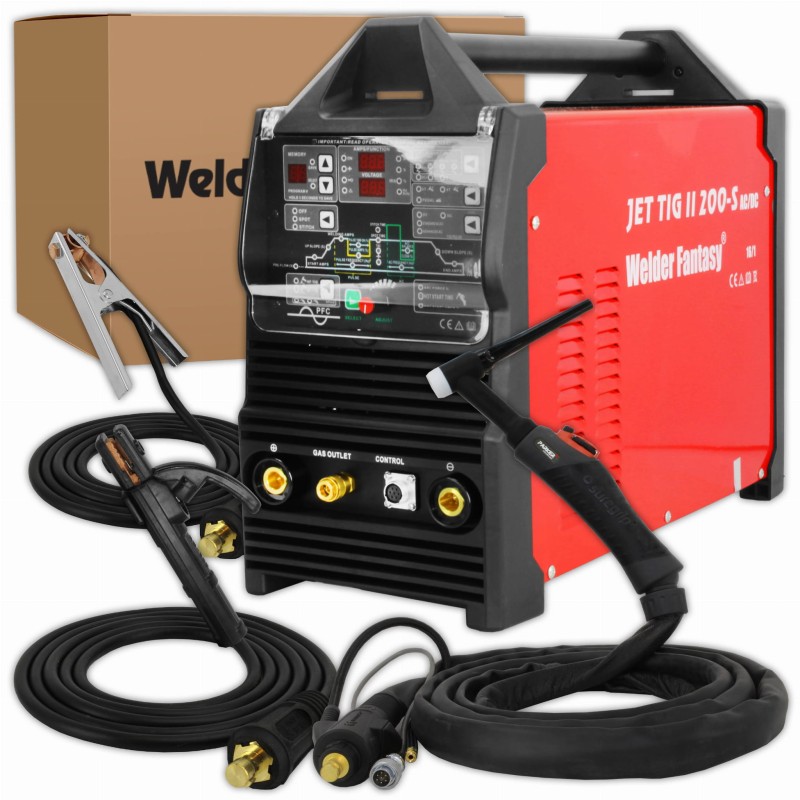
WELDER FANTASY INVERTER WELDING MACHINE JET TIG AC/DC 200-S SPOT/COLD
Producer: Welder Fantasy | Welding methods: MMA, TIG, | Power supply: 230V | Welding current: 200A | Efficiency: 60% |
STANDARD EQUIPMENT
- Welder Fantasy JET TIG II AC/DC 200-S IGBT welder,
- PARKER SUREGRIP SGT26 FLEX TIG SRT 26-4m welding torch - adjustable welding current,
- 3m mass holder,
- 3m electrode holder,
- User manual and warranty card.
- The device is equipped with an industrial plug 230V 32A.
Welder Fantasy is a brand created by FACHOWIEC in 1991. TIG/MMA inverter welders, MIG/MAG semi-automatic welding machines, plasma cutters and other equipment with the Welder Fantasy mark have been appreciated by thousands of workshops and enterprises in Poland and abroad for many years. The Welder Fantasy brand is:
- The highest quality of devices,
- Reliability guarantee,
- high working parameters,
- A leader on the Polish market.
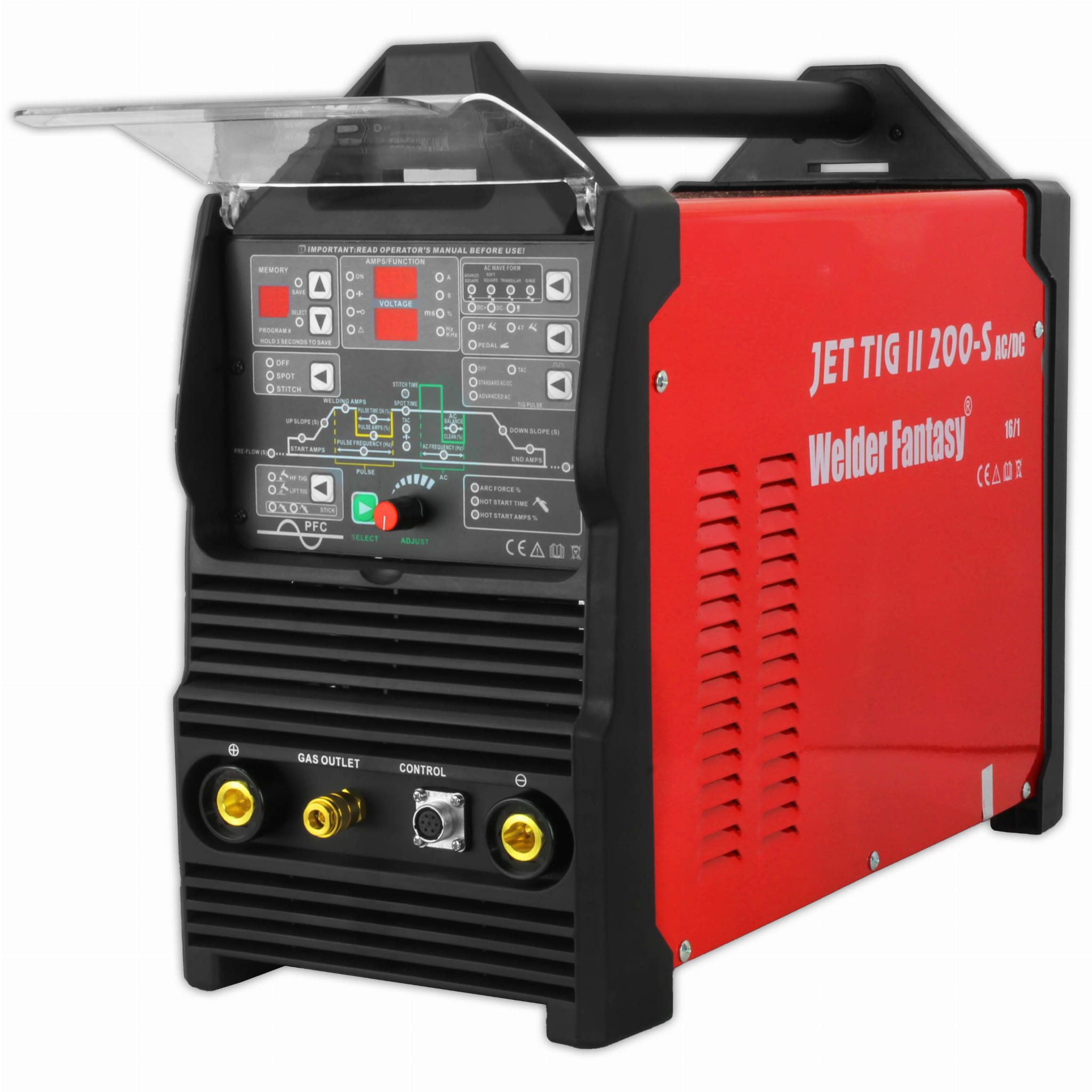
The top-class device sets new standards among AC/DC welding machines, and the user-friendly control panel ensures the selection of all necessary operating parameters.
Welder Fantasy JET TIG II AC/DC 200 SPOT IGBT industrial devices are microprocessor-based welding sources based on IGBT technology and adapted to welding:
- carbon, stainless and acid-resistant steels
- copper, brass, magnesium, titanium
- all aluminum alloys
TECHNICAL DATA:
- Power supply: 1~230V 50Hz
- Power consumption TIG/MMA: 6 kVA
- Time-delayed protection min.: 20A TYPE C
- Insulation class: F
- Housing protection degree: IP21
- Dimensions: 575x230x435 mm
- Weight: 26 kg
- TIG DC welding current range: 3-200 A
- TIG AC welding current range: 5-200 A
- TIG efficiency 60%: 200A
- TIG efficiency 100%: 160A
- Waveform waveform: square, trapezoidal, triangular, sine
- AC current frequency adjustment: 20-250 Hz
- Current balance in AC mode: 5%-95%
- Start gas / end AC/DC mode: 0-10 / 0-25 sec
- Initial / final current DC mode: 3-200 / 3-200 A
- Start/end current AC mode: 5-200 A
- Rise/fall time AC/DC mode: 0-10s / 0-10s
- AC/DC pulse base: 3-100%
- AC/DC Pulse Duration: 5%-95%
- Advanced AC mixed current frequency: 0.1-10 Hz
- Pulse current frequency Standard DC: 0.1-500 Hz
- Pulse frequency Standard AC Square (square): 0.1-250 Hz
- Pulse frequency Standard AC Soft Square, Triangular, Sine: 0.1-250 Hz
- TIG arc ignition function: HF (ionizer) / LIFT
- MMA / VRD MMA no-load voltage: 70 / 21 V
- MMA DC+ / DC- welding current range: 10-160 A
- Efficiency MMA 60%: 160 A
- MMA efficiency 100%: 130 A
- ARC FORCE: 0-100%
- HOT START TIME: 0-2 sec
- HOT START AMPS: 0-100%
IGBT TECHNOLOGY
Modern technology based on bipolar transistors with an insulated gate. It combines the ease of control of field effect transistors with the high breakdown voltage and switching speed of bipolar transistors. The use of IGBT technology significantly extends the reliable operation of welding equipment.
LEVEL OF SECURITY
IP defines the degree to which the device is resistant to the ingress of solid and water contaminants. IP21 means that the device is adapted to work in closed rooms.
MMA
A method that uses a coated electrode, consisting of a metal core covered with a sheath. The welder feeds the electrode as it melts into the workpiece so as to maintain a constant arc length. The device enables welding with all types of electrodes, e.g. basic, cellulose, rutile or acidic.
VRD
VRD (Voltage Reduction Device) function available in the MMA mode - a module that reduces the quiescent voltage (idling) of the secondary circuit of the device). Increases safety and reduces the risk of electric shock.
ARC FORCE
The arc stabilizing function by maintaining the value of the welding arc voltage regardless of its length and facilitating the control of the amount of spatter.
HOT START
When the arc is struck, the welding current is temporarily increased in order to heat the material and the electrode at the point of contact and to properly shape the penetration and weld face in the initial phase of welding
DEVICE ALLOWED FOR WELDING METHODS:
TIG DC lift-arc - In the TIG (Tungsten Inert Gas) method, the electric arc is ignited in a shield of inert gas (argon), between the welded element and a non-consumable electrode made of pure tungsten or tungsten with additives. In the TIG lift-arc mode, the arc is ignited when the electrode contacts the workpiece. In TIG DC mode, the current is constant.
TIG DC HF - In order to completely eliminate the possibility of tungsten contamination of the weld, it is recommended that the electrode does not touch the workpiece; for this purpose, contactless arc ignition is used using high-frequency discharges generated by the ionizer built into the device.
TIG DC PULS lift-arc - the arc is ignited by contacting the electrode with the material being welded, the pulse function allows welding of thin elements through periodic changes in current intensity.
TIG DC PULS HF - non-contact HF ignition with an ionizer in TIG DC PULS mode
TIG AC lift-arc - a function that allows you to weld aluminum by using alternating current, which performs the function of cathodic cleaning when welding aluminum. Thanks to the possibility of setting the AC BALANCE parameter, i.e. the balance of alternating current, it is possible to adjust the ratio of the duration of its phases to each other.
TIG AC HF - an analogous function for welding aluminum with alternating current, ignition is contactless through high-frequency current generated by the ionizer
TIG AC PULS lift-arc - welding in this mode is a combination of the use of alternating current with pulse, which allows welding of very thin aluminum elements. The arc is ignited by contact of the electrode with the welded material.
TIG AC PULS HF - a function that allows welding of thin aluminum elements. Non-contact ignition thanks to the use of an ionizer.
PANEL FUNCTIONS:
Possibility to use user-programmed factory settings for aluminum and steel welding (60 memory channels). Waveform selection:
- ADVANCED SQUARE - a rectangular AC waveform allows you to weld aluminum with the addition of magnesium
- SOFT SQUARE - a trapezoidal AC waveform is used for welding aluminum with the addition of silicon
- TRIANGULAR - setting the triangular current waveform is optimal for welding thin components, including anodized aluminum
- SINE - sinusoidal waveform is recommended for welding pure aluminum 99.999%
TIG AC + DC - the ADVANCED AC function enables welding with mixed current AC DC - In a single cycle, there is a transition between alternating current AC and direct current with negative polarity DC(-). This cycle is repeated throughout the welding process. Mixed current welding is particularly useful when joining elements of different thicknesses. It also reduces noise emissions compared to AC welding.
TIG COLD WELDING - the function generates high-power welding arc discharges in a very short time (up to 0.001s). This enables the joining of welded elements without the addition of a binder, including dissimilar materials. The COLD WELDING function is especially useful when joining elements with a thickness of less than 1mm, surfacing the edges and wherever it is important to heat the welded elements as little as possible.
MMA DC+ - The MMA method uses a coated electrode, consisting of a metal core covered with a coating. An electric arc is generated between the end of the electrode and the material to be welded. The arc is ignited by touching the tip of the electrode to the workpiece. MMA DC+ means welding with positive polarity - more heat is generated in the material and less in the electrode.
MMA DC- - the difference between MMA DC+ is that the polarity in the MMA DC - mode is negative, so the heat distribution is reversed - more heat is generated at the electrode and less in the welded material.
MMA VRD DC+ - available in the MMA DC+ mode, the VRD function (Voltage Reduction Device - a module that reduces the idle voltage of the secondary circuit of the device. Increases safety and reduces the risk of electric shock. The function turns off and on the welding power supply when the resistance is measured during welding between the ends of the electrode - the welded element.
MMA VRD DC- - available in the MMA DC- mode, the VRD (Voltage Reduction Device) function works in the same way as MMA VRD DC+, the difference is in the negative polarity.
SPOT
TIG SPOT welding is used for overlapping joining (tacking) of thin sheets (up to 1.5 mm, when drilled up to 5 mm - hole-point joint) made of steel, alloy steels, as well as for joining sheets before butt welding.
The method consists in introducing a short thermal pulse (0.1-4 s), during which the surface of the metal sheet affected by the electric arc is melted and welded to the metal sheet directly below it.
PULSE TAC
It enables an efficient way of joining thin sheets, while maintaining a small amount of heat input, which significantly reduces the deformation of the material. The high frequency of the pulsating current enables the creation of a weld pool very quickly, which results in the immediate creation of a weld, a tack.
In this mode, it is possible to pre-join the welded elements with a series of short welds, thus allowing the pre-positioning of the welded elements relative to each other.
ROUNDING THE ELECTRODE
It allows for a short-term ignition of the arc in order to melt the tip of the sharpened electrode and form a rounding on its top.
The rounded tip of the electrode prevents weld arc wandering, which can be caused by inadequate preparation of the non-consumable electrode. An additional advantage of using a rounded electrode is a greater penetration depth.
PFC
Power Factor Correction - increasing the power factor to a value as close as possible to 100% in order to reduce power losses in transmission lines.
2T/4T
2T - Pressing the welding torch button will pre-flow the gas, then ignite the arc and start welding. When the button is released, the arc will extinguish and the gas will flow.
4T - Pressing and releasing the welding torch button will pre-flow the gas, then ignite the arc and start welding. When the button is pressed and released again, the arc will be extinguished and the gas will flow.
PRE GAS
Adjustment of the shielding gas flow time before welding.
POST GAS
Adjustment of the shielding gas flow time after welding.
RISE TIME
Welding current rise time from the initial current to the set welding current value.
DOWN SLOPE TIME .
The time for the welding current to fall from the set value to zero or the value of the crater current.