


 Menu
Menu
Choose a category
- Soldering
- Tools
- Welding machines
- Weld bead cleaners
- Welding positioners
- Induction heaters
- Plasma cutters
- Rectifiers and starters
- Gas accessories
- Water coolers
- Trolleys
- Welding helmets
- Welding consumables
- Chemical
- Torches
- Abrasives
- Health and safety
- Spare parts
- Welding accessories
- Workshop tools
- Pneumatics
- New products
- Products on sale
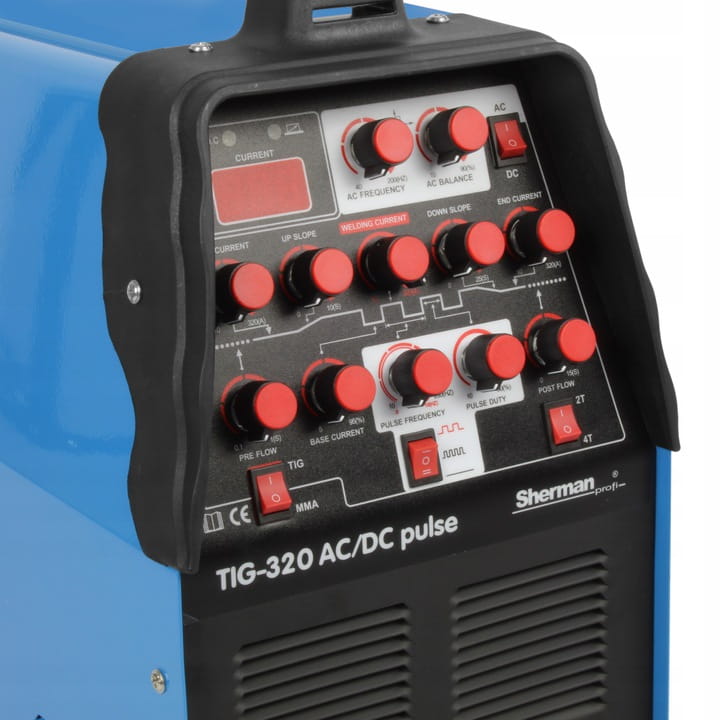
Sherman TIG 320 AC/DC pulse + cooler WS-7,5LT + pedal + trolley



Regular price:
product unavailable
add to wish list
Description
SHERMAN PROFI® TIG 320 PULSE AC / DC INVERTER WELDING MACHINE
Brand: SHERMAN | Welding methods: TIG AC / DC, MMA | Power supply: 400V | Welding current: 320A | Efficiency: 40%
STANDARD EQUIPMENT
- Sherman profi® 320 AC / DC pulse welding machine
- Welding holder T-18 / 4m
- 3m mass cable
- Gas hose
- Consumable parts of the handle (nozzles - 2 pcs, sleeves - 2 pcs and a long plug)
- User manual
- Warranty Card
ADDITIONAL EQUIPMENT
- Sherman WS-7,5LT cooler
- Control pedal
- Trolley platform
The TIG 320 AC / DC pulse welder is an inverter welding machine made in the IGBT technology. It is used for manual welding with direct and alternating current TIG and direct current with a coated electrode (MMA method).
It is widely used both in production and service works. It is designed to work in closed and roofed rooms.
The welder allows full adjustment and control of all welding parameters of the arc and pulse characteristics.
It has HF ignition, 2T / 4T function and welding current display.
The device has excellent welding properties, recommended especially for professionals.
HF
Tungsten electrode welding in a protective gas shield with a pilot arc (non-contact)
2T / 4T OPERATING MODE
In the two-tact mode, pressing the switch in the grip handle will turn on the ionizer and ignite the arc. Welding is carried out with the switch pressed. Releasing the switch will stop welding. In the four-time mode, pressing the switch in the handle of the handle will turn on the ionizer and the arc ignition should then be released and welding with the released switch. Pressing the switch again will stop welding.
IGBT TECHNOLOGY
The basis for the construction of the electric energy conversion system of the welding machine are electronic systems made in IGBT technology, enabling operation in the frequency range above 200 kHz
INITIAL CURRENT
The current that appears in the circuit after pressing the button in the handle of the handle. The higher the starting current, the easier it is to strike the arc. However, when welding thin sheets, too high a starting current can lead to burnout. In some welding modes, the current does not increase to heat the workpiece.
CRATER CURRENT
Current used in some welding modes when the arc is not quenched immediately after the welding current downslope. It allows you to fill the crater and the end of the weld.
BASE CURRENT
The current responsible for maintaining the welding process, the lower value of the current pulse. It facilitates the control of the amount of heat introduced into the material.
PULSE FREQUENCY
The frequency with which the current pulse value changes between the welding current and the base current.
PULSE WIDTH
Duration of the pulse allows you to adjust the depth of penetration. Increasing the width increases the penetration depth, reducing the amount of heat introduced into the material, reducing the risk of burning through thinner sheets or smaller components.
GAS PRE-FLOW TIME
The time from pressing the button in the handle of the handle until the arc is struck. Typically it should be longer than 0.5 seconds to deliver the shielding gas to the exit of the torch nozzle. to cover the starting point of welding and the tungsten electrode. In the case of a longer gas supply line from the cylinder, the pre-flow time should be longer.
GAS FLOW TIME
The time from the extinction of the arc to the closing of the gas valve. to shield the solidifying weld pool from air and to cool the tungsten electrode. Too short a post-flow time may result in oxidation of the weld. When welding in TIG AC mode (alternating current), this time should be longer.
RISE TIME
The time in which the welding current is upwardly from the starting current to the set welding current value.
DOWN TIME
Time for the welding current to fall from the set value to zero or the value of the crater current.
CURRENT FREQUENCY AC
Useful when welding aluminum. The higher the frequency, the better the quality of the weld, the better the focus of the arc
AC BALANCE
The ratio of the duration of the positive phase to the negative phase. Decreasing the balance introduces more heat into the material, resulting in a narrower weld and deeper penetration, while reducing the heat load on the tungsten electrode. Increasing the balance introduces less heat into the material, resulting in better cleaning, a wide weld and shallower fusion, however, significantly stresses the tungsten electrode.
MMA
MMA welding possible
TECHNICAL PARAMETERS
- Supply voltage AC 3x400V ± 10% 50Hz
- Maximum power consumption 9 kVA
- Rated welding current / duty cycle MMA: 270 A / 40%; TIG 320 A / 40%
- Rated no-load voltage 65 V
- Maximum current draw 15.2 A
- Network protection 16 A.
- Weight (without accessories) 32 kg
- Dimensions 545 x 255 x 540 mm
- Protection degree IP21
RANGES OF PARAMETER ADJUSTMENTS
- Gas pre-flow 0.1 - 1 s
- Gas post-flow 0 - 15 sec
- Current ramp up 0 - 10 s
- Downslope 0 - 25 s
- Initial current 10 - 320 A.
- Welding current: TIG: 10 - 320 A MMA: 10 - 270 A
- Base current 5 - 95% of the welding current
- Crater current 10 - 320 A.
- Pulse frequency 0.5 - 5 Hz & 10 - 200 Hz
- Pulse width 10 - 90%
- AC frequency 40 - 200 Hz
- AC balance 10 - 90%
PROTECTION AGAINST OVERHEATING
The power source is equipped with a thermal automatic overload switch.
When the temperature of the welding machine is too high, the protection disconnects the welding current and the overheating diode lights up. After the temperature has dropped, the switch will reset automatically.
WORK CYCLE
The duty cycle is based on a 10-minute period. Duty cycle of 40% means that after 4 minutes of operation, a 6-minute break is required. 60% duty cycle means that after 6 minutes of operation, a 4-minute break is required. 100% duty cycle means that the device can work continuously without interruption.
TIG HOLDER
- T-18 handle type
- Maximum current carrying capacity of 320 A
- Liquid cooling
- Liquid pressure 2.5 bar (max 3.5 bar)
- Minimum liquid flow 0.9 l / min
- Arc ignition Non-contact (HF)
- Length 4 m