


 Menu
Menu
Choose a category
- Soldering
- Tools
- Welding machines
- Weld bead cleaners
- Welding positioners
- Induction heaters
- Plasma cutters
- Rectifiers and starters
- Gas accessories
- Water coolers
- Trolleys
- Welding helmets
- Welding consumables
- Chemical
- Torches
- Abrasives
- Health and safety
- Spare parts
- Welding accessories
- Workshop tools
- Pneumatics
- New products
- Products on sale
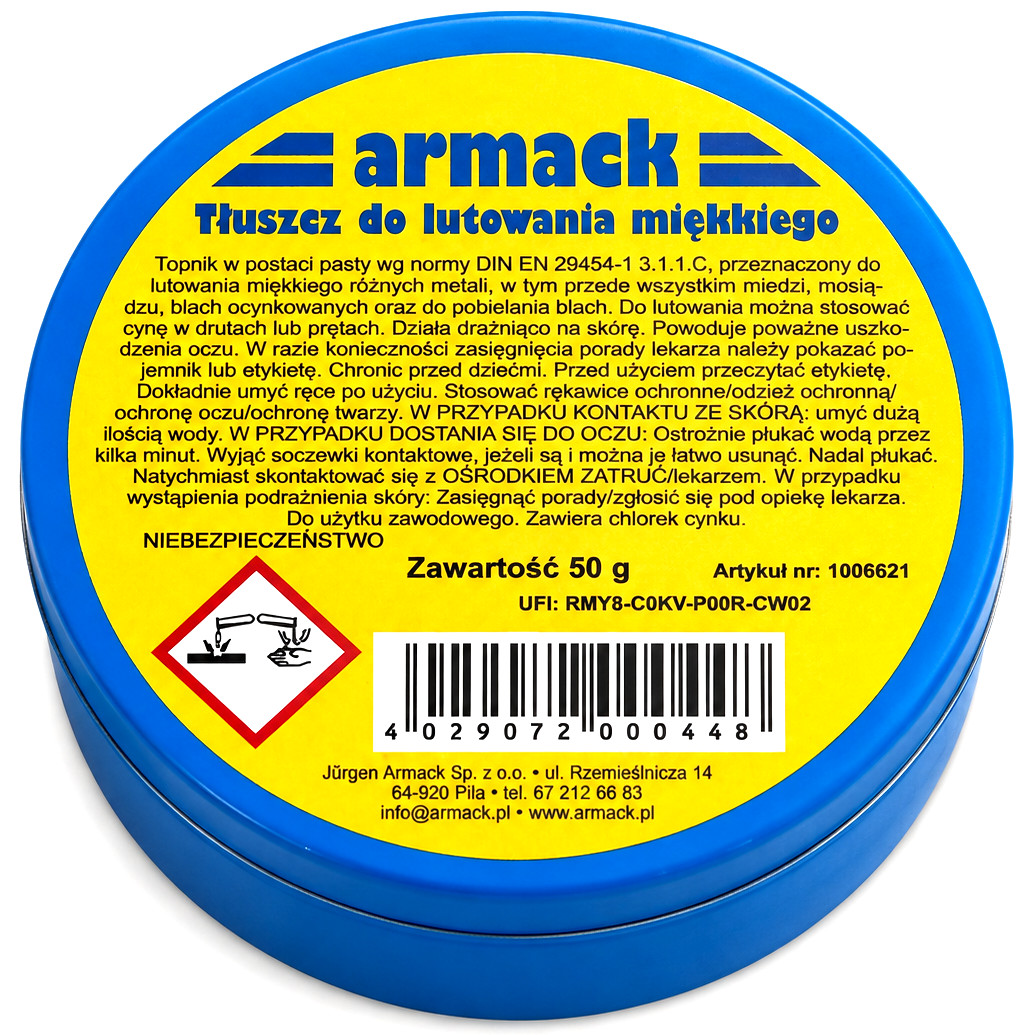
ARMACK soft soldering flux 50 g soldering paste
Regular price:
product unavailable
add to wish list
Description
⚡ ARMACK AMASAN Soft Soldering Flux 50 g
ARMACK AMASAN soft soldering flux, 50 g is a professional paste flux designed for soft soldering various metals. It is particularly well suited to joining components made of copper, brass and galvanised sheet metal, as well as tinning metal surfaces.
The product complies with classification DIN EN 29454-1 3.1.1.C (F-SW 21). The flux’s low surface tension supports the correct flow of solder, making it easier to create joints even in areas with restricted access.
✅ Key benefits of ARMACK soldering flux
- Designed for soft soldering – suitable for professional workshop, installation and repair work.
- For copper and copper alloys – suitable, among other things, for brass.
- For galvanised sheet metal – useful for sheet-metal and construction work.
- Suitable for tinning sheet metal.
- Good solder flow – the flux’s low surface tension facilitates the spreading of the filler metal.
- Helpful in hard-to-reach areas – makes it easier to deliver solder to the joint area.
- Paste form – convenient for controlled application with a brush directly to the surface.
- 50 g pack – practical for service and workshop work.
- The product has a PZH approval.
✅ Improved solder flow
During soft soldering, a suitable flux helps prepare the metal surface and supports the correct spreading of the filler metal. ARMACK soldering flux is characterised by low surface tension, which makes it easier for solder to flow across the prepared surface.
This is particularly important when making small joints and soldering components located in areas with restricted access.
✅ Applications
ARMACK AMASAN soft soldering flux can be used, among other applications, for:
- soft soldering copper,
- soft soldering copper alloys,
- soft soldering brass,
- soft soldering galvanised sheet metal,
- tinning sheet metal,
- metalworking,
- building and repairing radiators,
- soft soldering copper wires in automotive workshops,
- sheet-metal work,
- building and repair work.
✅ For repairing radiators and copper wires
ARMACK soldering flux is used when building and repairing radiators containing components made of copper and its alloys. It can also be used for soft soldering copper wires in automotive workshops.
Thanks to its paste form, the flux can be applied precisely to the intended joint location.
✅ For sheet-metal work and metalworking
The product is also suitable for metalworking, sheet-metal work and construction. It can be used when soldering copper, zinc and galvanised sheet metal, as well as for work requiring the tinning of metal surfaces.
✅ How to use soft soldering flux
Before soldering, the surface must be cleaned of dust, oil, grease and other contaminants. Apply the flux in a thin layer using a suitable brush for pastes and soldering products.
Next, heat the joint area and use a suitably selected soft solder.
After soldering, remove flux residues with a damp cloth.
✅ Suitable solders
Depending on the type of material being soldered and the purpose of the joint, the soldering flux can be used with:
- soft solders based on tin and lead,
- lead-free soft solders.
The specific solder should be selected according to the material of the joined components and the conditions in which the joint will subsequently operate.
✅ Technical data
- Manufacturer: ARMACK
- Series: AMASAN
- Type: flux / soft soldering grease
- Form: paste
- Weight: 50 g
- Classification: DIN EN 29454-1 3.1.1.C (F-SW 21)
- Application: soft soldering
- Materials: copper, copper alloys, brass, galvanised sheet metal
- Approval: PZH
- Catalogue number: 1006621
- EAN: 4029072000448
- CN code: 38101000
✅ Important information on use
The product is intended for professional use. Before soldering, surfaces must be thoroughly cleaned; after work is completed, flux residues must be removed.
Chemical products must be stored in appropriately labelled packaging, out of the reach of children. Suitable personal protective equipment must be used during work, and the information in the product safety data sheet must be followed.